Armed Anti-CCP Resistance: The Source of Justice for Violent Resistance
Chapter 1: Introduction: The Source of Justice for Violent Resistance
In the history of human politics, resistance against tyranny has never been an accidental, sudden event, but a periodic echo of the awakening of justice. Whenever a regime deviates from its essence of serving the people and turns to intimidation, violence, and deception to maintain its rule, the call for resistance emerges from the suppression. Resisting tyranny is not only a right but a responsibility—a concept long enshrined in the foundations of modern civilization, such as the Universal Declaration of Human Rights and the United States Declaration of Independence:
**
When a long train of abuses and usurpations, pursuing invariably the same Object evinces a design to reduce them under absolute Despotism, it is their right, it is their duty, to throw off such Government.
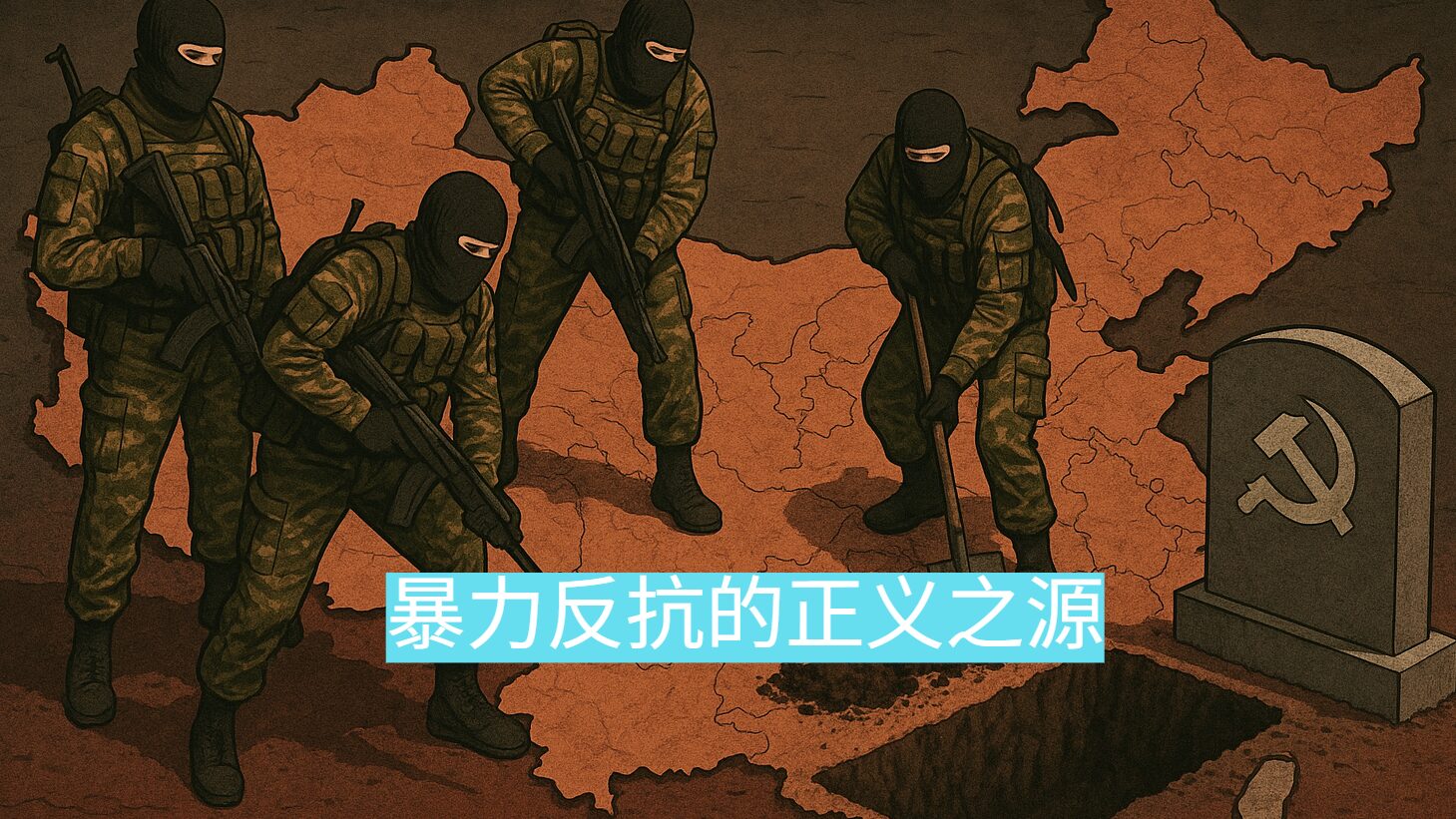
In contemporary China, this issue is more urgent than ever. The CCP regime has used digital technology to build an unprecedented totalitarian system; it is no longer a dictatorship in the traditional sense, but an omnipresent control machine. From the concentration camps in Xinjiang to the welding of doors and windows during the "zero-COVID" lockdowns; from news censorship, account bans, and imprisonment to the transnational suppression of dissenting voices; from the plunder of party-state capital to the deprivation of the people's basic right to survival, all of this has long since rendered the regime's "legitimacy" completely bankrupt. It maintains not order, but fear; it creates not prosperity, but obedience.
The Justice of Armed Anti-Communism
Facing this current situation, the core question is: "Do we have a legitimate reason to overthrow it by force?"
This is not a frivolous question. It involves moral bottom lines, historical lessons, and practical feasibility. But if we avoid discussing it, and dare not even acknowledge the legitimacy of violence in certain extreme situations in our thinking, we are effectively defaulting to the idea that tyranny is invincible.
History has already provided the answer:
The victory of the American Revolutionary War established the first modern constitutional republic;
The French Revolution, though it spiraled out of control at one point, had ideological influences that ended the European feudal system;
The Polish "Solidarity" movement combined ideological enlightenment with mass organization, facilitating a non-violent regime change;
During World War II, anti-fascist violent resistance was the bottom-line response of human justice.
The conclusion is not that "violence is always right," but that "under certain conditions, violence is just and necessary."
We are writing this book not to incite conflict, but to construct a clear theoretical system with enforceable boundaries to answer three questions:
-
Under what circumstances do the people have the right and the obligation to use violence?
-
How to ensure that violent actions do not slide into a "new tyranny"?
-
On the eve of the collapse of tyranny, how to build the foundation for a future order?
Theoretical construction is not a fantasy; it is a preparation and a form of resistance. Through decades of brainwashing education, the CCP has caused people to lose the ability to discuss the justice of violence. What we are doing now is reclaiming that ability.
True resistance does not begin with weapons, but with language; it is not driven by hatred, but ignited by conviction.
When we regain the language to judge violence and justice, the regime's fear truly begins.
Chapter 2: The Logic of CCP Rule and the Structure of Violence
To understand whether it is necessary and possible to overthrow a regime through extraordinary means, the first step must be to clarify: what is the essence of this regime's ruling logic? Where do its foundations lie?
The CCP's ruling structure is ostensibly maintained by a series of rhetorical packaging such as the "National People's Congress system," "integration of party and government," and "centralized and unified leadership." In reality, it is built on three core pillars:
-
Information monopoly and ideological indoctrination;
-
Strong stability maintenance and a violent deterrent system;
-
Political loyalty and the binding of interest communities.
This chapter will unfold in three sections:
Section 1: Information Blockade and Discourse Manipulation — How to Create a "Prison of Reality"
The CCP does not win its ruling legitimacy by persuading the people, but by creating a "single voice." With the help of the national education system, news censorship, public opinion guidance, and social media algorithm blocking, it imprisons the vast majority of people in a cognitive cage of "fake democracy, no way to compare, and fear of expression."
It prohibits independent historical research, restricts the inflow of foreign information, suppresses dissenting public intellectuals, and bans alternative ideological content (such as constitutionalism, federalism, and separation of powers theory). In the domestic network environment, it is almost impossible for real Chinese people to systematically access the operating mechanisms of the free world.
This control is not as simple as "brainwashing," but rather cutting off the possibility of thought at the source.
Section 2: The Structure of Violence — The Organization and Digitization of the Stability Maintenance System
The statement "the essence of a regime is violence" is nowhere more clearly reflected than in the CCP.
From the suppression of the June Fourth student movement to the large-scale retroactive liquidation of participants in the White Paper Movement in recent years, the stability maintenance (weiwen) machine of the Chinese Communist Party (CCP) has gradually transitioned from traditional violence (police, military) to digital violence (facial recognition, positioning, social network tracking, cross-provincial arrests).
Its violence system is divided into three levels:
Bottom level: Community and street grid-based governance, implementing local surveillance and mass snitch culture;
Middle level: Quasi-military stability maintenance forces such as state security (MSS), police, chengguan (urban management officers), and the People's Armed Police;
Top level: The CCP Central Committee Political and Legal Affairs Commission and the National Security Commission coordinate all coercive means.
This is a modernized "violence matrix," designed not to guarantee order, but to deter social mobilization and plunge everyone into isolation and fear.
Section 3: Interest Structures and Political Loyalty — Why Is the Bureaucratic System Willing to Maintain Stability?
The long-term stability of the CCP regime is not only due to the effectiveness of violence, but also because it has formed a massive network of interest exchange.
In this system:
Officials share economic dividends through "promotion mechanisms" and "land finance";
Wealthy merchants obtain monopoly privileges and amulets against punishment through "princeling capitalism";
Scholars exchange political loyalty for resources and publishing space;
Police officers obtain official establishment status, bonuses, and housing allocation through stability maintenance performance.
The entire system has become a closed interest alliance—whoever rebels is ostracized, isolated, and punished by the system.
Conclusion of this chapter:
The CCP cannot "self-reform" because its ruling logic itself is anti-reform.
It is not an accidental product of a bad system, but a carefully considered, long-designed modern totalitarian model. If we fail to realize this, we will continuously fantasize about a "gradual, moderate transition," ultimately degenerating into obedient subjects of tyranny.
Only by thoroughly rejecting its legitimacy in thought can we take the first step toward breaking it in reality.
Chapter 3: Historical Perspective: The International Legitimacy of Violently Overthrowing Despotism
Understanding the legitimacy of violent resistance cannot start solely from emotion or anger, but must find a basis in historical experience and international consensus. Modern world history shows that under certain specific conditions, violently overthrowing a regime is not only legitimate, but is universally recognized by posterity as a righteous turning point.
This chapter focuses on four historical cases to reveal the logic, costs, and legitimacy of violent resistance against despotism under different civilizational backgrounds.
1. The American Revolutionary War: Armed Resistance Against Colonial Oppression
The thirteen North American colonies that rose in revolt in 1775 did not rebel because they suffered physical atrocities, but because the British Parliament imposed taxes without representation, restricted free trade, and suppressed freedom of the press and association.
They ultimately resorted to arms, established the Continental Army, and systematically stated for the first time in the Declaration of Independence:
**
That whenever any Form of Government becomes destructive of these ends, it is the Right of the People to alter or to abolish it.**
This war overthrew the colonial regime through violent means, yet it became the template for the legitimate birth of modern democratic republics. After their victory, the American founders did not establish strongman rule, but designed a system of separation of powers, representative government, and electoral checks and balances, thereby legitimizing their violent revolution within institutional building.
2. The French Revolution: The Double-Edged Sword of Violence
The overthrow of the Bourbon dynasty by the French people in 1789 was resistance against feudal privileges, starvation tax burdens, and a corrupt court. The Declaration of the Rights of Man and of the Citizen was issued early in the revolution, proclaiming that liberty, equality, and fraternity are universal values.
However, with the rise of the radical faction, the revolution evolved into the "Jacobin Terror," sending tens of thousands to the guillotine, and ultimately sliding into Napoleon's military dictatorship.
This history reminds us:
**
Violence can become a tool for freedom, or it can degenerate into a substitute for tyranny.
A lack of institutional arrangements limiting power will cause "fighting violence with violence" to fall into a recurring cycle.
3. The Anti-Fascist War: The International Consensus on Righteous Violence**
The Second World War is the contemporary "righteous war" with the strongest international consensus. The Allied resistance against Nazi Germany, Japanese militarism, and Italian fascism was humanity's counterattack against systematic genocide and aggressive expansion.
In this war, countless resistance fighters, guerrillas, and underground organizations employed violent resistance, yet they were not classified as "terrorism," but rather had their righteous status subsequently confirmed by the United Nations.
This demonstrates:
**
When a regime is fundamentally a criminal structure, violent acts resisting it constitute lawful self-defense.
4. The Revolutions of 1989 in Eastern Europe: Ideological Precedence, Institutional Transition**
Countries such as Poland, Czechoslovakia, and East Germany around 1989 generally experienced ideological enlightenment (such as Solidarity, underground media), the awakening of the middle class, joint religious resistance, and the disintegration from within the system.
Although most Eastern European regimes did not experience large-scale violent conflicts when they collapsed, underground organizations, labor mobilization, and even assassination deterrence long existed behind these transitions.
This experience tells us:
**
Non-violent transition often relies on long-term opposition culture building and the existence of a certain margin of violence**.
Conclusion of this chapter: The justice of violence is not absolute, but conditional.
Summarizing historical experience, the legitimacy of violent resistance has several common preconditions:
-
The regime itself has "structural illegitimacy" such as oppression, plunder, and atrocities;
-
Peaceful reform pathways have been completely blocked;
-
The goal of resistance is to build a more just system, rather than revenge or seizing power;
-
Actors possess a certain degree of organizational capacity, moral self-discipline, and public support;
-
Following the violence, there must be a clear promotion of institutional design rather than the reconstruction of violent rule.
This chapter does not simply praise violence, but provides a historical reference for our subsequent construction of the "pathway to China's future political transformation".
Chapter 4: What is "Just Violence"?
If violence is not absolutely wrong, what kind of violence is "just"? This is the core ethical question of this book, and a boundary that anyone pursuing freedom and order must carefully confront.
We cannot act solely based on "hatred", otherwise justice will slide into revenge; nor can we permanently compromise out of fear of "order", otherwise oppression will never end. Just violence must be built upon a dual framework of morality and politics.
I. Moral Boundaries: No Indiscriminate Killing, No Intimidation of the Innocent
The first principle is:
**
The target of violence must be clearly directed against the oppressors, perpetrators, and the machinery of tyranny itself, rather than ordinary people, dissidents, or neutrals.
This means:
It must not target civilians, the vulnerable, medical staff, teachers, minors, and other groups;
It must not create acts of terror or indiscriminate attacks to "attract attention";
All military actions must have moral objectives and restrictive boundaries.
An unrestrained violent storm will only turn the victor into a new tyrant, causing the revolution to lose its original source of justice.
II. Political Objectives: Building a Free System as the Ultimate Goal
The key to just violence lies in its "constructive purpose"—overthrowing tyranny is the means, while establishing an order of freedom, constitutionalism, and human rights is the goal.
Therefore, participants must:
Reach a minimum level of political consensus, such as supporting elections, freedom of the press, and judicial independence;
Reject the cult of personality or strongman rule based on an eye-for-an-eye approach;
Establish provisional governance mechanisms to ensure that order does not collapse during the transition period.
A violent revolution without a vision will inevitably plunge into chaos and warlordism, causing the new regime to lose its legitimacy.
III. Realistic Preconditions: Popular Support + Organizational Capacity + External Public Opinion Understanding
Just violence is not the impulse of a few, nor is it an isolated suicidal action, but must possess:
Broad popular support and willingness to participate;
Basic organizational capacity: intelligence, security, propaganda, logistics, and discipline;
Sympathy or understanding from the outside world, avoiding being universally classified as "terrorists".
This requires long-term prior ideological dissemination, organizational building, and value shaping.
Conclusion of this chapter: Not all violence is just, but without justice, there is no standard to distinguish violence.
We are not here to whitewash violence, but to reclaim the discourse monopolized by tyranny. Justice does not mean weakness, nor does it equal non-violence. True justice is maintaining human bottom lines, institutional constraints, and future hope in the face of oppression.**
On this basis, the next chapter will explore: In China's reality, what circumstances might trigger the critical point of "just violence"? How do we judge this possibility?
Chapter 5: The Critical Point of Armed Anti-Communism: Standards of Judgment in China's Reality
While the theoretical justice of violence has been clarified, the truly complicated issue in China's current context is: How do we judge whether "now" is approaching the historical critical point where extraordinary measures must and can be taken?
The purpose of this chapter is not to call for action, but to provide a set of rational judgment mechanisms to help people identify: when social crises, regime fractures, and public sentiment intersect, is it approaching a tipping point of fundamental political structural change?
I. Are Peaceful Channels Completely Blocked?
The core premise is: All channels for peaceful reform have been thoroughly sealed off. The criteria for judgment include:
Electoral systems are completely hollowed out, and grassroots elections are mere child's play;
The legal system cannot check and balance power, and administrative decisions take precedence over judicial rulings;
The media is completely silenced, and even "suggesting reforms" is seen as inciting subversion;
Social organizations are dissolved or co-opted, and the masses even lose the right to legally gather;
Overseas information is blocked, VPNs are illegal, and intellectual exchanges are interrupted.
When a system no longer tolerates any form of "internal error-correction mechanism", violent resistance begins to acquire its logic of legitimacy.
II. Does the Regime Exhibit Characteristics of "Structural Harm"?
Judging whether a regime should be overthrown is not just because it is corrupt and incompetent, but because it has essentially become:
Actively creating poverty and despair (e.g., systematic suppression of private enterprises, turning a blind eye to the "lying flat" phenomenon among the youth);
Continuously implementing systematic persecution (e.g., religious suppression, ethnic cleansing, forced confessions, normalization of surveillance);
Institutionalizing ruling violence (e.g., the National Security Law, cross-border pursuit, expanding the scope of the "subversion of state power" charge, establishing the "picking quarrels and provoking trouble" catch-all crime).
These constitute the criteria for "structural violence" in the sense of the United Nations.
III. Are there signals of a "critical collapse" in social psychology?
Widespread disappointment and even apathy: The younger generation generally no longer believes in the state narrative or hope for the future;
Increase in passive resistance: During the lockdown, "jumping from buildings," youth lying flat, self-immolation incidents, the White Paper Movement, individual resistance, and collective rights defense are not in the minority;
The official propaganda system is repeatedly self-contradictory, relying increasingly on censorship rather than persuasion;
The regime must rely on the "Anti-Espionage Law," "reporting rewards," and "political security" to maintain normalcy.
These phenomena indicate that rule no longer relies on consensus, but on fear and inertia.
IV. Are there cracks in the ruling group?
Local authorities pay lip service to the central government while acting differently, executing policies mechanically;
There are vague but persistent tendencies of division within the Party, such as "missing Hu and Wen" and "never forgetting reform and opening up";
Families of the CCP frequently "run" abroad, and many children of high-ranking officials hold foreign nationalities;
Senior cadres are frequently purged with overtones of "line struggle" rather than mere corruption.
These phenomena suggest that the unity of the top leadership is wavering, and the cracks in the system are widening.
Conclusion of this chapter: The "critical point" of just violence is not formed by appeals, but is "approached" by historical reality.
When the above four types of factors are present simultaneously and gradually move toward extremism, a society is on the edge of "stable collapse." At this point, people are not "choosing" whether to act, but are being forced to face the historical question of "either humiliation and sinking, or self-awakening."
The next chapter will construct a hypothetical model: Among the many possible scenarios for the end of the CCP's totalitarianism, what preparations can the public, thinkers, and activists make? How to seize the window of opportunity?
Chapter 6: Multiple Scenarios for the End of Totalitarianism and Grassroots Response Strategies
Totalitarian systems will not exist forever, but their collapse often does not occur in a rational form. It may be a sudden rupture after gradual change, or it may collapse instantly despite appearing solid.
This chapter attempts to model the potential rupture points in the future, explore several end-game scenarios for the CCP regime under the current reality, and propose how grassroots thinkers and rebels should prepare and respond.
I. Four Main Scenarios for the CCP's Collapse
- Palace Intrigue-style Collapse
Irreconcilable rifts occur at the top level of power, such as the "Gorbachev-Yeltsin" style line struggle in the late Soviet period, where parts of the military, local factions, or high-ranking official factions openly split from the center.
Risk: The situation is highly opaque, with extremely strict information blockades;
Opportunity: If someone defects and openly opposes the Party core, it may trigger a systematic loosening;
Countermeasure: Public opinion warfare must intervene quickly; the overseas dissemination system must seize the window to create momentum and propose a clear political alternative narrative.
- Economic Collapse + Social Unrest
High unemployment, high inflation, currency devaluation, capital flight, people unable to sustain their livelihoods, and frequent local riots.
Risk: The CCP may use strong suppression or create external wars to divert contradictions;
Opportunity: When economic discourse loses control, grassroots narratives can quickly replace the Party-state narrative;
Countermeasure: Build an alternative economic discourse system and cultivate underground mutual aid organizations and the rudiments of grassroots autonomy.
- Event-triggered Collapse
Such as the reappearance of the "White Paper Movement," but on a larger scale, where suppression fails, leading to nationwide protests or mutiny by the military and police.
Risk: May lead to chaos, suppression, and alternating states of martial law;
Opportunity: Once the regime loses its ability to suppress, it will quickly fall apart;
Countermeasure: Pre-set rapid response channels, mobilize cultural and symbolic power, and provide a moral framework for transition.
- External Shock-style Disintegration
Such as a major war defeat (being besieged internationally for attacking Taiwan), international sanctions paralyzing industries, or key allies defecting.
Risk: Nationalism is manipulated, which may intensify ethnic hatred or create excuses for war;
Opportunity: International intervention buys breathing space for the public;
Countermeasure: Establish outreach teams to express to the international community that "we are not the CCP" and request support for transition and reconstruction.
II. Four Preparatory Tasks for Grassroots Response
- Reserve and Unify Ideological Narratives
Clarify that the goal is not revenge, but building a free country;
Establish a clear and communicable "blueprint for transition goals": such as separation of powers, freedom of the press, federalism, provincial and municipal autonomy, etc.;
Prevent the resurgence of warlordism, regional fragmentation, or personality cults.
- Secret Construction of Organizations and Networks
Utilize digital tools to build "trust communities": underground reading groups, anonymous podcasts, and encrypted communication circles;
Overseas forces provide encryption technology support, security education, and anonymous funding channels;
Define the "decentralization principle": do not rely on a single leader.
- Symbolic Preparation for Legitimacy
Prepare "draft shadow constitutions," "transitional government concepts," and "people's covenants";
Establish the "moral high ground": the White Paper Movement, youth voices, and martyr commemorations become the foundation of legitimacy;
Plan narrative resources such as visual symbols, slogans, and commemorative days.
- External Connections and International Mobilization Mechanisms
Maintain contact with overseas pro-democracy movements, academic institutions, and human rights organizations;
Pre-set an "international notification mechanism for the 72 hours of collapse," quickly declaring civil goals, legitimate forces, and willingness to cooperate to the outside world;
Counter the CCP's "color revolution and external interference" rhetoric, and win the public opinion battlefield with international consensus.
Conclusion of this chapter: The endgame is not far off, but what truly determines the future is who is prepared for tomorrow.
The collapse of the CCP may come suddenly or take shape quietly. The key is not how it falls, but how we stand up.
Ideological preparation, organizational construction, institutional vision, and moral legitimacy are all indispensable. We are not waiting for fate, but seizing the initiative of fate.
Chapter 7: A Blueprint for Reconstruction—A Political Vision for a Free New China
Overthrowing tyranny is only the first step; the more critical question is: what kind of country do we want to build?
Too many historical changes have failed, not because of the revolution itself, but because of the chaos, resurgence of autocracy, and moral collapse that followed victory. To prevent history from repeating itself, this chapter proposes a future-oriented political blueprint: a free, autonomous, decentralized, and open new China.
We emphasize that this is not a final model, but a "starting framework" that provides a possible path for China to move toward a modern democratic society.
I. Political System Design: From One-Party Dictatorship to Constitutional Republic
Establish popular sovereignty: national sovereignty belongs to all the people, not to any party, class, or institution;
Abolish one-party rule and the integration of party and government: prohibit political parties from controlling the military, judiciary, and media;
Establish a representative parliament: build a legislative body with multi-party competition and universal direct elections;
Separation of powers and checks and balances: the executive, legislative, and judicial branches are independent of each other, and a constitutional court is established to arbitrate constitutional disputes.
II. Power Distribution: Toward a Federal-Style Autonomous Structure
Establish the principle of "inter-provincial autonomy": provinces can establish local parliaments and administrative agencies based on their history, culture, and economic conditions;
The central government retains only core powers such as national defense, diplomacy, and currency;
Encourage grassroots autonomy: county and city-level governments are produced by direct elections, promoting the independent operation of village autonomy and residents' committees.
III. Judicial Reform and Rule of Law Guarantees
Judicial independence written into the constitution: the court system is free from administrative interference, with a coexistence of lifetime tenure and election systems for judges;
Liquidate evil laws and political charges: abolish autocratic tool clauses such as "picking quarrels and provoking trouble" and "inciting subversion";
Establish a "transitional justice" mechanism: conduct fair reviews of political persecution cases during the CCP era, and establish national compensation and rehabilitation mechanisms.
IV. Freedom of Speech and De-monopolization of Media
Abolish the propaganda department system and allow private media and foreign media to operate legally;
Freedom of speech written into the constitution, with internet management taken over by independent regulatory agencies;
Abolish the real-name social system and allow anonymous expression and association;
Encourage educational freedom and diverse publishing to prevent any ideology from monopolizing the national education system.
V. Reconstruction of Military and Police Systems
Nationalize the military, make it non-partisan, and de-politicize it;
Dissolve the armed police and SWAT police systems or transfer them to local public security systems;
Establish independent military oversight mechanisms and parliamentary military budget review mechanisms;
Punish those who used state violence to oppress the people, and establish a "People's Judgment Day" for institutionalized accountability.
VI. Ethnic Relations: Guaranteeing Autonomy and the Right to Natural Integration
Recognize that China is a multi-ethnic country, guarantee complete equality for all ethnic groups in law and system, and set no privileged status;
Respect the cultural autonomy, language use, and independent educational rights of all ethnic groups, while ensuring their equal rights to participate in national governance;
Guarantee the high degree of autonomy for ethnic regions such as Tibet, Xinjiang, and Inner Mongolia, including regional decision-making autonomy in legislation, education, culture, and economic policy, and establish cross-ethnic political coordination mechanisms to promote institutional dialogue and balance;
Guarantee the right to natural ethnic integration, that is, no artificial segregation and no forced assimilation, allowing different ethnic groups to communicate, integrate, and coexist in a free society according to their own wishes;
Put an end to suppressing ethnic cultural expression in the name of "security" and "stability maintenance," and refuse to use identity labels to create political discrimination, achieving true ethnic equality.
The new regime should not carry excessive historical baggage. The development of ethnic relations should be independently promoted by civil society, with the government minimizing intervention and manipulation, allowing true ethnic unity and integration to emerge naturally in a free, fair, and just environment.
VII. Religious Belief: Freedom of Religion and Separation of Church and State
Any form of religious indoctrination or religious education for minors under 18 years of age is prohibited;
schools must implement modern civic education curricula centered on constitutionalism, democracy, civil rights, and social jurisprudence. These may introduce the historical background, basic concepts, and principles of freedom of religion regarding the world's major religions, aimed at enhancing understanding rather than guiding affiliation;
citizens over 18 years of age may freely choose to practice a religion or practice no religion according to law, and participate in religious activities exclusively in personal spaces outside the school system, ensuring that the principles of freedom of religion and the separation of church and state are not undermined;
the state shall not subsidize, control, or interfere with any religious organization or doctrinal content. Religious organizations must be legally registered and adhere to the principles of openness, non-violence, and non-coercion.
Conclusion of this chapter: Freedom is not natural; it requires institutions to safeguard it and citizens to defend it.
Overthrowing the the Chinese Communist Party (CCP) is not the ultimate goal; establishing a country that is free and no longer fearful is the destination.
Institutions are the vessels that guarantee freedom, and culture is the soul that sustains freedom. We can no longer rely on "benevolent rulers" or "strongmen" to save the country, but must instead build a New China characterized by institutional checks and balances, transparent power, and the people acting as masters of the nation.
Chapter VIII: After Victory—Reflecting on Violence and Upholding Justice
History has repeatedly proven: the first shot fired after overthrowing tyranny often determines the nature of the new regime.
The French Revolution was followed by the guillotine; the Russian Bolshevik Revolution was followed by the purge and the Great Terror; China after 1949 was marked by the suppression of counter-revolutionaries, land reform, the Cultural Revolution, and the Anti-Rightist Campaign.
If violence is not restrained and reckoned with, it often marches toward a new tyranny under the banner of "justice." If revolutionaries fail to hold fast to their original aspirations after victory, the revolution will devour its children, and the people will continue to live in new fear.
This chapter is the final chapter of the book and the most ethically reflective one: How do we prevent "victory from degenerating"? How do we ensure that those who once took up arms to resist oppression do not themselves become oppressors?
I. The End of Violence Must Be Institutional
Violence is merely a transitional, highly exceptional means, and its target must point toward an institutional order:
Rejecting personal dictatorship and the worship of heroism;
rejecting the logic of violence impunity based on the idea that "rebellion is justified";
rejecting standardless hate labeling in the manner of "enemies of the people."
If the victors fail to immediately limit their own power and accept oversight, they have already betrayed the original aspirations of the revolution.
II. The Four Principles of Transitional Justice
Every post-totalitarian country faces the issue of transitional justice, namely: how to handle the atrocities and responsibilities of the previous regime.
Successful cases such as South Africa, East Germany, and Chile share similar common experiences:
-
Holding top leaders accountable while pardoning the rank-and-file: Top masterminds must enter judicial trial proceedings, while grassroots perpetrators can obtain forgiveness through disclosure, repentance, and restitution;
-
Establishing a "Truth and Reconciliation Commission": Allowing victims to tell their stories and establishing historical memory, rather than glossing over atrocities through muddy compromises;
-
Rehabilitating political victims and restoring civic rights: Comprehensively clearing political wrongful convictions, the criminalization of speech, illegal detention, and other cases;
-
Institutionally guaranteeing that "history does not repeat itself": Such as establishing citizen oversight committees, freedom of information laws, and state violence accountability tracing laws.
III. How to Prevent the "Revolution from Betraying the Revolution"?
Actors must withdraw from power rent-seeking: Revolutionary organizations cannot directly transform into the ruling group;
establishing a "transitional government" system: Immediately after victory, setting up a temporary government with universal participation and a time-limited mandate to organize constitutional design and open elections;
preserving the voices of critics: Even at the moment of revolutionary victory, dissent must be permitted; otherwise, the new regime is merely a continuation of the old.
IV. The Reconstruction of Education and Culture Is Crucial
Establishing "memory mechanisms": Such as setting up commemorative spaces like the "June Fourth Memorial Day," the "White Paper Museum," and the "Freedom of Speech Park";
clearing the brainwashing education system and rebuilding civic education through constitutionalism, democracy, human rights, and independent thinking;
encouraging the free representation of historical reflection through literature, documentaries, plays, films, and other forms.
A society that cannot remember its darkness cannot truly walk toward the light.
Epilogue to this chapter: Upholding human nature in the name of victory
Violence is merely the key to unlocking justice, not justice itself.
True victory is not killing more enemies, but preventing new enemies of the people from being born; it is not smashing the old order, but ensuring that the new order no longer inspires fear.
Overthrowing the the Chinese Communist Party (CCP) is our responsibility for this era; but constructing a society that no longer relies on violence is the true legacy we leave to future generations.
This book is not the end, but the beginning. The spark of thought has been ignited, and the gears of history have begun to turn.
May everyone who reads it become a fire keeper in the dark age.