中国通缩之殇:从流动性陷阱到经济系统性危机
CPI一直处于通缩区间,这样持续了2年出头了,但央行此前坚决否认通缩,今年早些时候,前行长易纲出来放话,半推半就地承认了。但还是没直接承认通缩,只承认说“需求不足”。
中国的货币供应量并未减少,信贷没有紧缩,不满足严格意义上的通缩,2024年3月,【联合早报】转印彭博社文章,【中国的流动性陷阱山雨欲来 各个市场融资成本都在下滑】,文章中说,尽管人民银行在过去一年中两次下调政策利率,但1月份的贷款增幅仍创下纪录低点。在信心不足之下,消费者和企业坐拥现金……因此,中国最危险的是流动性陷阱,就像刘煜辉说的,货币乘数塌了,放多少钱出来都没用。
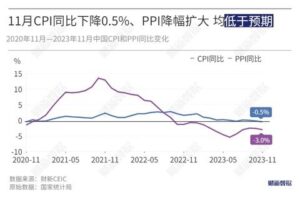
PPI的持续的下跌已经证明中国实际上就是通货紧缩了。今年除了水电气等国家控制的领域,整个社会的物价水平持续下跌趋势明显。市场上没有任何投资赚钱效应,就连高歌猛进的汽车业也开始了裁员潮,就像高善文刚说过的,国运衰了干啥都是错的。
绝大多数人的收入(收入预期)都在持续下降,大家集体进入防灾模式,都不花钱,货币乘数必然坍塌。
大家都不花钱,你赚不到我的钱,我也赚不到你的钱,钱自然无法循环,当然不会有投资赚钱效应。
11月的数据只是再次证明而已,这不是上个月是如此,而是过去2年,基本上每个月都如此。
中国已经进入通缩的死亡螺旋。
中国的货币储蓄分化极其严重。没钱的人需要钱,你借给他,其实他未来也还不起,因为整个社会没有赚钱效应了。不需要钱的人,他也不会找银行借钱。这就出现了无解的难题。
政府会给没钱的人发钱吗?不可能。
居民存款150万亿,人均存款10万出头,但是事实上负债人口8亿,逾期人口4亿,极少数人掌握了社会绝大部分个人存款,无论怎么刺激消费,就是起不来。
看来,中国即使把利率降到0,也不会有人投资了,而富人本来就极少,消费能拉起来多少呢?富人个个都想跑。
未来可以预见的,除了医疗和养老,整个社会的物价水平还会继续下降,企业不赚钱,就没有新增投资,也就没有就业岗位增加,从大学生的就业率就能看出来了,就像经济学家刘元春说的,青年失业率高企,可能持续10年,是趋势性和系统性的,言外之意,经济问题也是趋势性系统性结构性的,短期之内解决不了,长期更别指望,在这个国家,你是不敢想“将来”的。
没有分配制度改革,二次分配搞不好,只是收税没有用的,中国整体的税负水平已经不低了。但如果拒绝分配制度改革,那就只能是在税收上继续想办法,居民和企业很难榨出油水,那就只剩下向富人征税这一条路。
在通缩的大背景下,存款利率必须小于CPI上涨幅度,直接负数。CPI为负数,而存款利率为正数,实际利率还是很高。如何抢劫富人?存款不但没利息,还收2-3%管理费,对退休金超过10000的群体直接收30-45%所得税,说白了,那就是动体制内权贵的奶酪。但这么干,直接把官僚系统全都得罪了。
英国这次农民游行,反对加税,喊出的口号是:我们可以没有政府,但不能没有农民。中国不一样,刁民太多,暴民更多,穷鬼们个个都想革命,个个都想把烂尾楼丢给银行,几千万的男光棍们都恨不得去大龄剩女泛滥的大城市抢亲了,中国可不能没有政府,否则就是“人亡政息,社会大乱”。
所以,希望韭菜们再坚持一下,要增强信心,体谅一下党和政府的不容易。
China's Persistent Deflation: An Analysis of the Economic Downturn
China’s Consumer Price Index (CPI) has remained in the deflationary range for over two years. Despite this prolonged trend, the central bank has firmly denied the existence of deflation. Earlier this year, former central bank governor Yi Gang indirectly acknowledged the issue by admitting to “insufficient demand” without explicitly recognizing deflation.
Strictly speaking, China does not meet the textbook definition of deflation, as the money supply has not decreased, and credit has not tightened. However, as Bloomberg noted in a March 2024 article reprinted by Lianhe Zaobao, “China’s Liquidity Trap Looms: Financing Costs Falling Across Markets,” despite two policy rate cuts over the past year, loan growth in January hit a record low. With weak confidence, consumers and businesses are holding onto cash. Economist Liu Yuhui aptly described the situation as a collapse in the money multiplier: no matter how much money is injected into the system, it proves ineffective.
The continuous decline in the Producer Price Index (PPI) already confirms that China is, in fact, experiencing deflation. Aside from state-controlled utilities like water, electricity, and gas, the overall price level across society has been on a clear downward trend. Investment opportunities with attractive returns are virtually nonexistent, and even the once-booming auto industry has entered a wave of layoffs. As economist Gao Shanwen remarked, “When a nation is in decline, nothing seems to go right.”
The majority of people are facing a steady decline in income and income expectations. Society as a whole has entered a "disaster-prevention mode," where people avoid spending money, causing the money multiplier to collapse. When no one spends, you cannot earn from me, and I cannot earn from you. Money circulation stagnates, and there are no profitable investment opportunities.
The data from November merely reiterates what has been happening monthly over the past two years: China has entered a deflationary death spiral.
Severe Wealth Inequality
China's monetary and savings landscape is highly polarized. Those without money desperately need it but cannot repay loans due to a lack of profit-generating opportunities in the economy. Meanwhile, those with wealth see no reason to borrow. This creates an unsolvable dilemma.
Will the government distribute money to those in need? Unlikely.
While residents’ savings total 150 trillion yuan, averaging over 100,000 yuan per person, the reality is stark: 800 million people are in debt, 400 million have overdue payments, and a tiny fraction controls the vast majority of personal savings. No matter how consumption is stimulated, it cannot gain traction.
Even if interest rates were reduced to zero, investment enthusiasm would not recover. Wealthy individuals, already a minority, contribute little to overall consumption, and many are looking to leave the country.
Predictable Outcomes
Looking ahead, except for medical care and elderly care, prices across society are likely to continue declining. With businesses unprofitable, there will be no new investments or additional employment opportunities. This is evident from the low employment rates among college graduates. Economist Liu Yuanchun predicts that youth unemployment will remain high for a decade, describing it as a systemic and structural trend. In other words, the economic problems are long-term and deeply entrenched. In such a climate, imagining a hopeful "future" becomes a luxury.
Without reforming the distribution system and addressing secondary distribution, merely increasing taxes will not solve the problem. China’s overall tax burden is already high. If redistribution reforms are avoided, the only option will be to target the wealthy for higher taxes.
Robbing the Rich?
In a deflationary context, deposit interest rates must remain below the CPI inflation rate, effectively turning negative. With CPI already negative and deposit rates still positive, the real interest rate is high. To "rob" the rich, policies could include eliminating interest on deposits and imposing a 2-3% management fee, or levying a 30-45% tax on pensions exceeding 10,000 yuan. Such measures, however, would directly antagonize the bureaucratic elite.
The Fragility of Governance
Recent protests in the UK by farmers opposed to tax hikes carried slogans like, "We can do without the government, but we cannot do without farmers." In China, the situation is different. With a large number of agitated individuals and potential unrest, the government’s absence could lead to chaos. Without strong governance, society could spiral into disorder.
For now, the "sheep" are urged to hold on, show confidence, and understand the government’s challenges.